
Before accepting a Poland factory or warehouse offer from the UAE, run it against six numbers. Each one is published by a named authority, each one is checkable, and any offer that fails the first is not worth pursuing regardless of what it promises.
Here they are, with sources and what each one should change about your decision.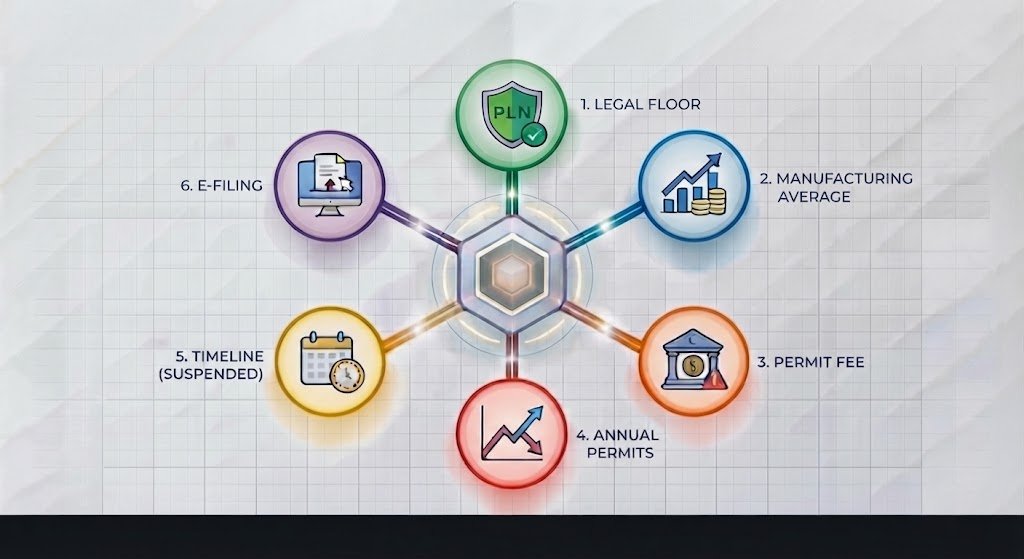
1. PLN 4,806: The Legal Floor
Poland’s minimum wage for 2026 is PLN 4,806 gross per month, effective 1 January 2026, under a regulation of the Council of Ministers dated 11 September 2025 (Journal of Laws, item 1242). The equivalent civil-contract hourly rate is PLN 31.40.
One detail makes this more useful than in previous years: there is no mid-year adjustment planned for 2026, so this figure holds for the full calendar year. You can check an offer against it in January or October and get the same answer.
No employer can legally pay below it for full-time work, and no permit application should rest on an offer that does. If your contract shows a lower figure, stop there and ask why before paying any fee.
2. PLN 8,982: The National Manufacturing Average
Average manufacturing pay across Poland was PLN 8,982 per month in July 2026, according to Statistics Poland (GUS).
Read this number carefully, because it is easy to misuse. It averages every experience level, every region and every role in manufacturing, including supervisors and long-tenured technical staff. A first contract for a newly arrived foreign worker typically sits far closer to the PLN 4,806 floor than to this figure.
Its real use is as a ceiling reference. It tells you the sector is not capped near the minimum, and that progression after your first contract is a realistic expectation rather than a sales line.
Two things typically move a worker up from the floor toward that average: time with the same employer, and language. Supervisory and machine-operator roles generally require functional Polish, which is why workers who invest in the language early tend to see their pay move within the first two years while those who do not stay closer to entry level.
Treat the first contract as the entry point rather than the destination, and judge an employer partly on whether progression is something they can actually describe.
3. PLN 400: What Your Permit Costs the Government
Since 1 December 2025, a work permit for a job longer than three months carries a PLN 400 government fee, up from PLN 100, per the European Commission’s Migration and Home Affairs portal. Permits up to three months cost PLN 200, and seasonal permits remain PLN 100.
The fee is non-refundable whether or not the permit is issued. Weigh it, plus any service fee, against the salary on offer, and be sceptical of any quote that still cites the pre-December figure. Full breakdown in the real cost of a Poland work permit.
4. 251,525 and Minus 22%: Both True at Once
Poland issued 251,525 work permits to non-EU nationals in 2025, 29% more than 2024 and more than double the 2019 level, according to Poland’s Ministry of Family and Social Policy. Indian nationals received 29,524 and Nepali nationals 18,805.
The same period also saw permits fall 22% overall across 2025 after mid-year policy tightening, reaching the lowest levels in seven years by the end of the year.
Both figures describe the same twelve months. The annual total was a record; the direction through the year was downward. For you this means demand is real but narrowing, which is an argument for a well-prepared application now rather than a casual one later.
5. 60 Days, Currently Suspended
Polish law expects a complete work permit application to be decided within 60 days, per the European Commission’s Migration and Home Affairs portal. That deadline is suspended for most decisions until 4 March 2026 under an Act passed 12 September 2025.
Factor this into when you can realistically expect to start earning, and do not resign from a UAE job against a promised date. See how long the process really takes.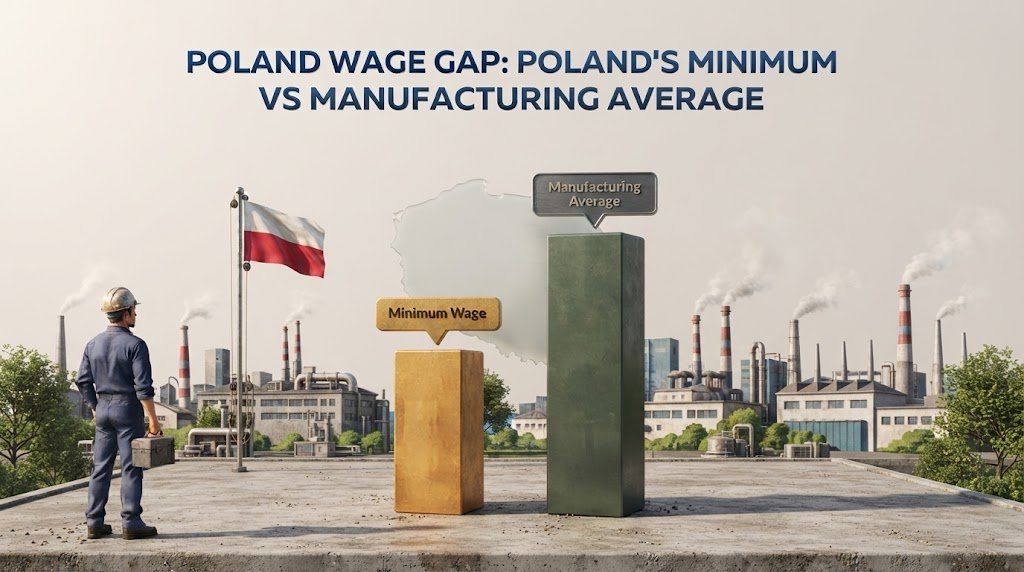
6. 1 June 2025: The Date Filing Went Electronic
Since 1 June 2025, work permit applications and attachments must be filed exclusively through the praca.gov.pl portal.
This is a salary-relevant fact, not just an administrative one. Your contract is now assessed on screen as a scanned document. If it does not clearly state your job title, monthly salary and contract duration, the caseworker cannot verify it against the PLN 4,806 minimum, and an unverifiable contract is a refusal risk. Details in the document checklist.
7. Gross vs Net: Which Number Are You Being Quoted?
The single most common misunderstanding in this whole conversation, and it is worth more than any of the figures above.
Poland’s PLN 4,806 minimum is a gross figure, meaning before income tax and social contributions are deducted. Your take-home pay is meaningfully lower. Polish employment carries statutory deductions covering pension, disability, sickness and health insurance, plus income tax, and these are withheld before you are paid.
Those deductions are not a loss. They are what fund your access to public healthcare and what build your contribution record, which matters for longer-term residence and for any future pension entitlement in the EU. But they do change what lands in your account each month.
So ask one question about any offer: is this figure gross or net? A reputable employer or consultancy answers immediately and can explain the approximate difference. An offer quoted without specifying, or quoted as a net figure that happens to equal the gross minimum wage, deserves a closer look.
Then budget from the net figure against real living costs, which are set out in life in Poland after your permit arrives.
What Should You Ask Before Signing?
Five questions, all of which a genuine employer can answer without hesitation.
Is the quoted salary gross or net? Is accommodation provided, subsidised, or entirely your responsibility? What are the contracted hours, and how is overtime paid? What is the contract length, and what happens at the end of it? And which company is named on the work permit application, since that is the employer you are legally tied to.
The last one matters most. Your permit authorizes work for one named employer. If the company paying you turns out to be different from the company on the permit, your legal position is not what you think it is.
What Does a Sound Offer Look Like?
It states a monthly salary at or above PLN 4,806 in writing, names the employer, shows the PLN 400 government fee separately from any service fee, and comes with a realistic explanation of timing rather than a guaranteed date.
An offer that clears all four is worth pursuing. One that fails any of them is worth questioning before money moves, not after.
If you are holding an offer and want it checked against these six numbers, send it to the Rapidline team on WhatsApp and we will tell you how it measures up.


Rapidline Immigraion