
A Polish residence permit lets you travel visa-free across the Schengen area for up to 90 days in any 180-day period. It does not let you work anywhere except Poland. That single distinction is the most misunderstood part of this route, and getting it wrong can cost you the permit itself.
Poland has been a full Schengen member since 2007. Here is precisely what that membership does and does not give a UAE-based worker.
When Does the Schengen Access Actually Begin?
Not when your work permit is approved. The travel right comes from being legally resident in Poland, evidenced by your residence card, rather than from the work permit itself.
The sequence runs: employer obtains your work permit, you obtain a national type D visa, you travel to Poland, you register and obtain your residence card. Free movement within Schengen attaches at the residence stage, not at the permit stage.
This trips up applicants who expect to travel around Europe immediately on arrival. Your type D visa gets you into Poland; the residence card is what opens the rest. The full sequence is in the complete Poland work permit guide.
What Does the 90 in 180 Rule Mean in Practice?
You may spend up to 90 days in any rolling 180-day period in other Schengen states. The window rolls continuously, so it is not a calendar-year allowance that resets each January.
For most workers this is generous, because it is designed for travel rather than residence. Weekend trips, visiting family elsewhere in the EU, and short business travel all sit comfortably inside it. Time spent in Poland itself does not count against the allowance, since Poland is where you legally reside.
Where people get into trouble is treating the allowance as an extension of a job search, spending long stretches in another country while nominally resident in Poland.
Can You Work in Another Schengen Country?
No, and this is the limit that matters most. Your Polish work permit authorizes employment with one named employer in Poland. It carries no employment rights in Germany, France, the Netherlands or anywhere else in the area.
Working elsewhere on the strength of a Polish permit is unauthorized employment in that country. The consequences reach back to your Polish status, because immigration violations anywhere in Schengen are visible across the area and count against future applications, including residence renewals in Poland.
If you genuinely want to move to another EU country later, the legitimate path is a separate work authorization from that country, applied for properly, often easier once you already hold EU residence and a work history.
Why Does This Still Change the Decision?
Because the comparison is not really Poland against a better-paid Gulf contract. It is Poland against every other route into Europe.
A Gulf residence visa keeps your options inside the Gulf. A Polish residence permit puts you inside the Schengen area with legal status, a work history in the EU, and the ability to travel across most of the continent without applying for a visa each time.
For workers who would otherwise find EU access effectively closed, that structural difference is the actual value of the route, more than the monthly salary figure. What that salary looks like in practice is covered in what factory workers in Poland actually earn.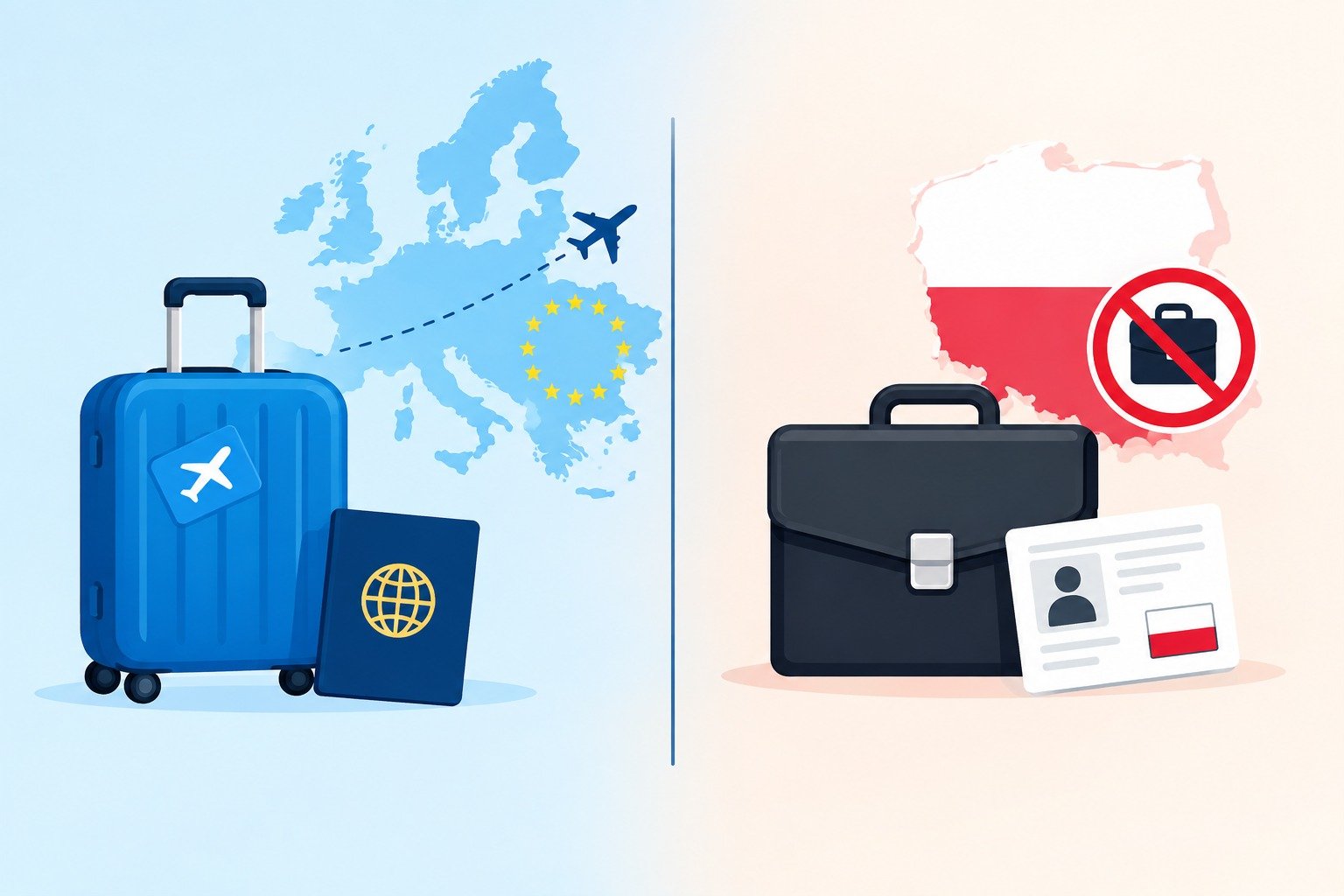
Does Everyone in Europe Give the Same Access?
Not quite, and it matters if you are comparing countries. Poland, Hungary, Lithuania, Latvia, Estonia, Slovakia and the Czech Republic are all full Schengen members, so residence permits from any of them carry equivalent travel rights.
Romania and Bulgaria are EU members whose Schengen position has changed in recent years, so confirm current status before treating their routes as equivalent for travel purposes. A full country-by-country comparison sits in Poland versus other European work visas.
What Does It Mean for Your Family?
A common assumption is that Schengen access extends automatically to relatives. It does not.
Your travel rights belong to you as a residence permit holder. Family members need their own legal basis to enter or stay, usually through family reunification, which is a separate application with its own conditions on income, accommodation and the length of your own residence.
This matters for planning. Workers who arrive expecting to bring family within a few months often find the timeline is longer and the conditions more demanding than they assumed, particularly the requirement to demonstrate stable income and suitable housing.
The practical approach is to treat your first contract as the foundation for a later family application rather than a shortcut to one. A clean record, a stable job and secure accommodation are the things that make the second application straightforward.
Does This Access Improve Over Time?
Yes, and this is the part of the route with the most long-term value.
Short-stay travel rights are the immediate benefit. What accumulates quietly alongside them is a legal residence record in an EU member state, and that record is what later applications are assessed against, whether for permit renewal, longer-term residence status, family reunification, or a move to another member state through that country’s own process.
Time spent legally resident and employed counts for something in a way that time spent on short visits never does. This is the practical argument for treating compliance as a priority rather than an inconvenience: the value of the route compounds only if the record behind it stays clean.
It is also the honest answer to workers comparing a Poland offer against a higher-paid Gulf contract on salary alone. The salary comparison is a one-year comparison. The residence record is a five-year one.
How Do You Keep the Access Safe?
Carry your residence card when crossing internal borders, since the absence of routine checks does not remove the obligation to prove your status when asked. Track your days outside Poland against the 90 in 180 window rather than estimating. Never work outside Poland on this permit. And keep your Polish registration current, because your residence status is the thing the travel right hangs from.
Overstaying or unauthorized work anywhere in the area puts both your permit and any future European application at risk. The access is genuinely valuable, which is precisely why it is worth protecting.
One further habit is worth building early. Keep a simple record of your trips outside Poland, the dates you left and returned, because the 90 in 180 calculation is cumulative across all Schengen states rather than counted per country. Workers who travel frequently for short visits are the ones most likely to drift over the limit without noticing, since no single trip feels significant.
Entry and exit records are increasingly captured electronically at the area’s external borders, so the assumption that short trips go unrecorded is not a safe one. Keeping your own record costs nothing and means you can answer a question about your movements with certainty rather than an estimate.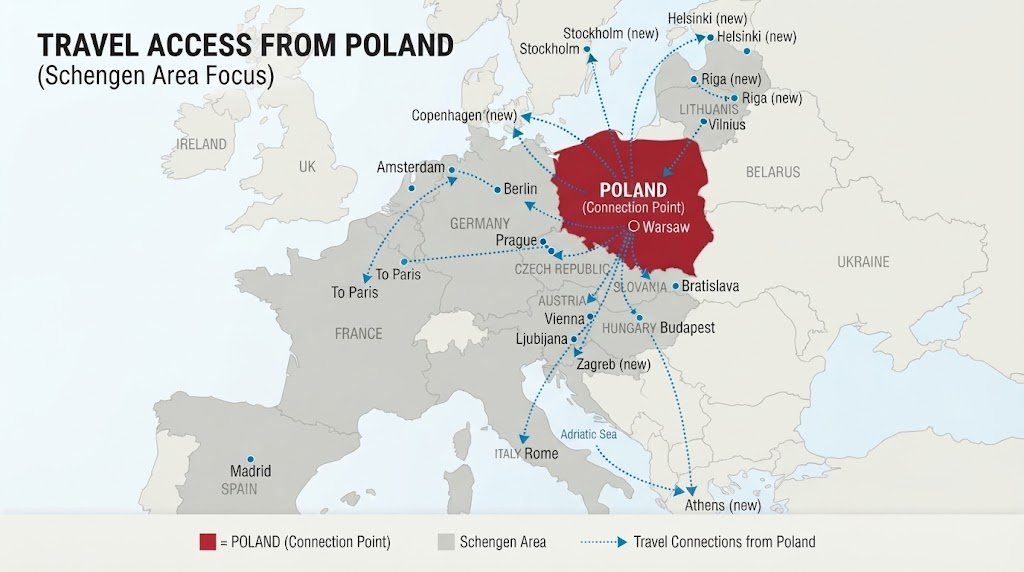
What Should You Do With This?
Treat Schengen access as a benefit of legal residence rather than a shortcut around it. Plan your first year around building a clean record in Poland, since that record is what makes everything afterward, renewals, family reunification, longer-term residence, considerably easier. What those first weeks look like is set out in life in Poland after your permit arrives.
If you want to talk through what the route realistically opens up for your situation, message the Rapidline team on WhatsApp.


Rapidline Immigraion