

In January 2026, Dubai Police’s Anti-Fraud Centre issued a public warning that “fraudsters are targeting people with false promises of employment and visa sponsorship, which have no legal backing.” Their guidance was direct: “The only safe way to obtain a work visa is through official government channels or licensed recruitment agencies.”
A police force does not issue a statement about a rare problem. Here are six checks you can run yourself, before any money moves.
Check 1: Does the Sequence Make Sense?
A genuine Poland work permit follows one order and never deviates from it. Your employer files a permit application at a Polish voivodeship office. The permit is issued. Only then do you apply for a national type D visa at the consulate.
Any offer to arrange a visa, guaranteed entry or a “direct” route without a permit already filed describes a process that does not exist. If you are being asked to pay before an employer has submitted anything, you are paying for a promise rather than a procedure.
The full legitimate sequence is set out in the complete Poland work permit guide.
Check 2: Do They Know the Fees Changed?
This is the fastest competence test available to you, and almost nobody uses it.
Poland raised work permit fees on 1 December 2025. Per the European Commission’s Migration and Home Affairs portal, a permit for a job longer than three months now costs PLN 400, up from PLN 100, and the fee is non-refundable if the permit is not granted.
Ask what the government fee is. An operation still quoting PLN 100, or unable to name a figure at all, is working from outdated information or has never filed one. Either way, that is not who should be handling your file.
Check 3: Will They Separate the Fees in Writing?
A legitimate consultancy can show you two numbers: the PLN 400 government fee, and their own service fee. The first is public and fixed by regulation. The second is theirs to justify.
An operation that offers only one lump sum, with no breakdown, is either avoiding comparison or does not know the real cost. Ask for the split in writing. A firm acting in good faith sends it without hesitation, because there is nothing in it that hurts them.
More on reading a quote properly in the real cost of a Poland work permit.
Check 4: Can They Name the Employer?
A work permit application names one specific Polish employer and one specific job. There is no such thing as a generic permit you collect first and match to a job later.
You are entitled to know the company’s name before committing money. If an agent cannot or will not name it, there may not be one yet. “We will place you on arrival” is not how the permit system works, and an application cannot be filed without an employer behind it.
Check 5: Are They Promising a Date?
Nobody can, right now. Poland suspended its standard 60-day processing deadline for most permit decisions until 4 March 2026 under an Act passed 12 September 2025. Offices are not bound to any timeframe and are not required to report delays.
So a guaranteed approval date, a “45 days maximum” promise, or a 100% success claim is not confidence. It is a claim nobody legally handling your file is in a position to make. Genuine firms explain the uncertainty instead of selling around it, as covered in how long a Poland work permit really takes.
Check 6: Who Is Filing, and How?
Since 1 June 2025, work permit applications and attachments must be submitted electronically through the praca.gov.pl portal. Paper submission is no longer accepted.
Ask how your application will be filed. Someone genuinely handling these cases will describe the electronic process without hesitating. Vagueness on this point, or a description of walking papers into an office, signals someone who has not filed an application recently, or ever.
Check 7: Does the Salary Figure Hold Up?
A fake offer is often generous on paper, because an unrealistic number is what makes people stop asking questions.
Poland’s minimum wage for 2026 is PLN 4,806 gross per month under a regulation of the Council of Ministers dated 11 September 2025. Average manufacturing pay nationally was PLN 8,982 in July 2026 according to Statistics Poland, and that average covers all experience levels and regions.
So a general-labor offer quoting well above the national manufacturing average, for a first contract, with no relevant experience required, is describing something that does not match the market. An offer below PLN 4,806 is a different problem: it fails the legal minimum and cannot support a valid permit application.
Genuine offers sit in a believable band and state the figure in writing as a gross monthly amount. Realistic ranges are set out in what factory workers in Poland actually earn.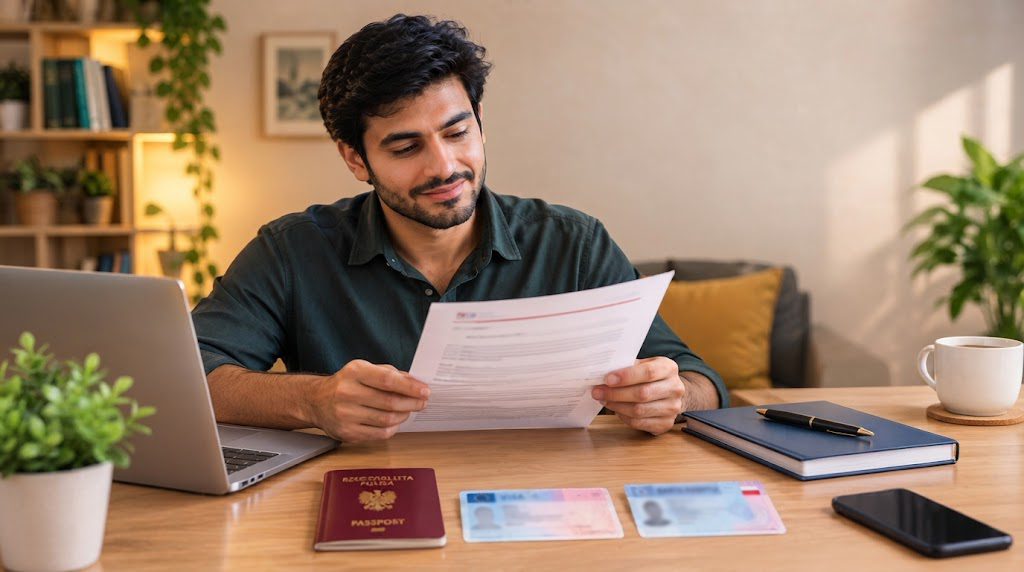
What Pressure Tactics Should Make You Stop?
Urgency is the common thread in almost every account of these schemes, because a decision made quickly is a decision made without checking.
Watch for a deadline that only exists on their side: a quota closing this week, a price rising on Friday, an employer who will “give the slot to someone else” by tomorrow. Real permit applications do not work on that rhythm. Employer demand is real, but no legitimate process collapses because you took three days to verify something.
Watch also for payment methods that leave no trace, and for requests that shift channel, moving from a company email to a personal messaging account, or from an invoice to a personal transfer. A firm that can issue a written quote can also accept a traceable payment.
And treat reluctance to answer any of the checks above as an answer in itself. A legitimate operation loses nothing by being verified, which is the single most useful thing to remember here.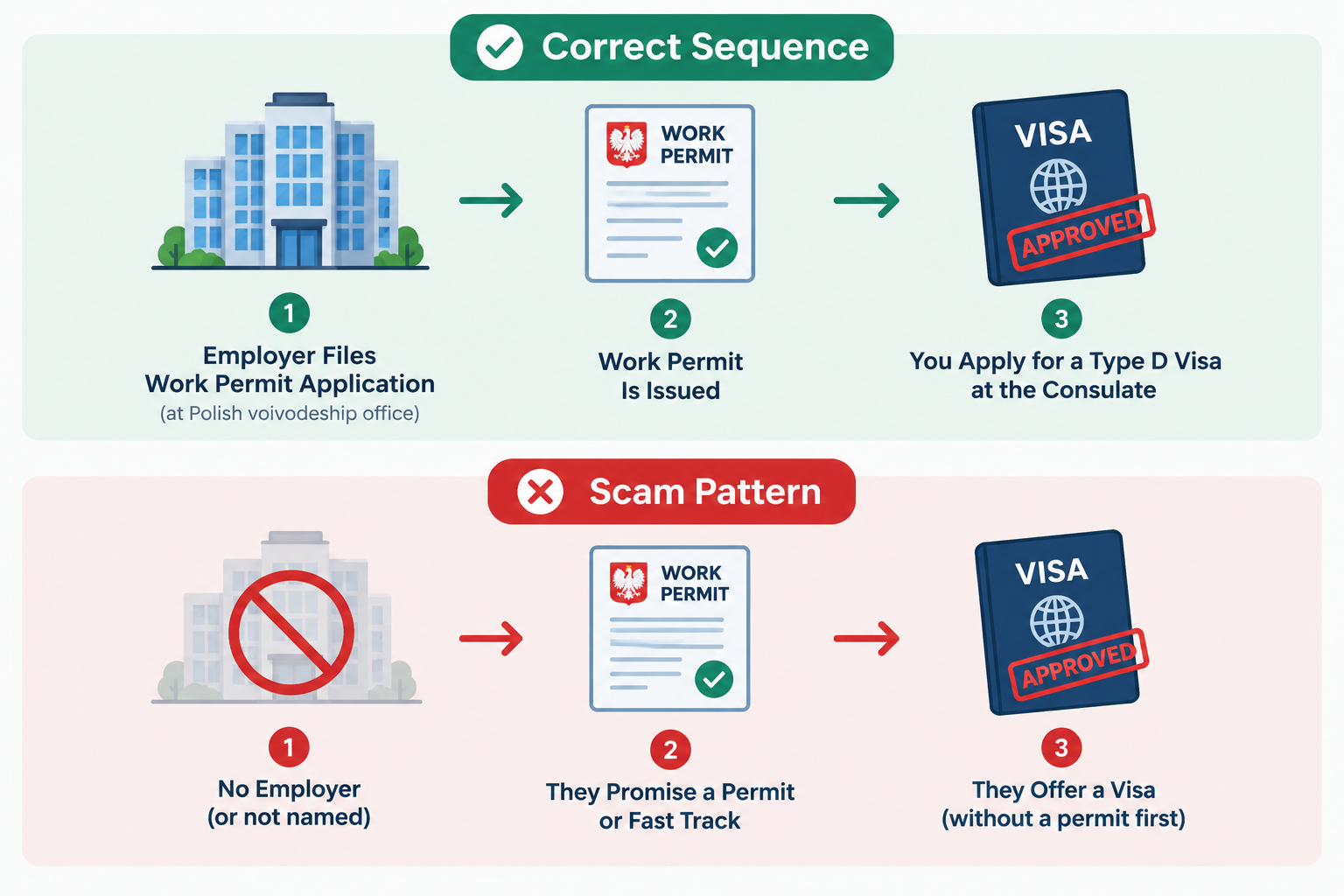
What If You Have Already Paid Someone?
Do not let sunk cost drive the next decision. Ask for the employer’s name, the application reference, and proof of submission. A real application exists in a system and can be evidenced.
If those cannot be produced, stop sending further money and seek advice. Dubai Police’s Anti-Fraud Centre is the appropriate channel in the UAE for suspected fraud, and their January 2026 guidance points applicants toward official channels and licensed agencies for exactly this reason.
What Does a Genuine Offer Look Like?
It names the employer. It shows the PLN 400 government fee separately from the service fee, in writing. It quotes a realistic salary at or above Poland’s PLN 4,806 monthly minimum for 2026. It explains that no date can be guaranteed while deadlines are suspended. And it describes an electronic filing through praca.gov.pl because that is the only way it happens now.
None of that requires trust. All of it is checkable, which is the point.
If you want an offer checked against these six points before you pay anyone, send it to the Rapidline team on WhatsApp. We will tell you plainly what we see, including if the answer is that it looks fine.


Rapidline Immigraion