


Longer than the law promises, and right now nobody can tell you exactly how long. Poland set a 60-day deadline for deciding a complete work permit application, then suspended that deadline for most decisions until 4 March 2026. Anyone quoting you a guaranteed turnaround is guessing.
Four myths drive most of the frustration UAE applicants feel about timing. Here is what is true instead.
Myth 1: Is “60 Days” a Guarantee?
No, and it never was. The European Commission’s Migration and Home Affairs portal states that under Polish law “the procedure should end within 60 days from the day of making a complete application.”
Read that sentence carefully. The clock starts from a complete application, not from the day your employer first submits something. If a document is missing, the 60 days have not started, no matter how long the file has been sitting with the office.
Under an Act passed 12 September 2025, Poland suspended this deadline entirely for most temporary and permanent residence and work permit decisions until 4 March 2026. The stated reason was a surge in applications from Ukrainian nationals overloading the same offices that handle your case. Offices keep accepting and deciding applications; they are simply not bound to the deadline and are not required to report delays.
So the number you have read on every competitor’s blog describes a rule that is, for now, switched off.

Myth 2: Does Every Office Move at the Same Speed?
It does not. Poland’s work permits are decided by regional voivodeship offices, and their caseloads differ sharply by region and by season. An identical file can clear faster in a lower-traffic region than in a busy one.
This explains something that confuses a lot of applicants. Two workers, same agency, same kind of job, same month, and very different waits. The variable is often the office rather than the agency.
You usually cannot choose the office, because it follows the employer’s location. What this should change is your expectations, not your strategy.
Myth 3: Does Paying More Make It Faster?
It does not, and this is worth being blunt about. The government fee is fixed by regulation, not negotiable, and paying a larger service fee does not buy priority in a queue that has no priority lane.
Since 1 December 2025 the work permit fee is PLN 400 for jobs longer than three months, up from PLN 100, per the European Commission’s Migration and Home Affairs portal. The fee is also non-refundable if the permit is not issued.
What a good consultancy actually buys you is fewer errors, not faster processing. That distinction matters when comparing quotes, which we cover in the real cost of a Poland work permit.
Myth 4: Is the Delay the Government’s Fault?
Often it is not. The single most common cause of a long wait is an incomplete file, because an incomplete file never starts the clock.
Since 1 June 2025, applications and attachments must be filed electronically through praca.gov.pl. Everything is now assessed on screen. A scan that is cut off at the edge, a contract that does not state the salary, or a name spelled differently across two documents all create the same outcome: a request for correction, and weeks lost.
That is the part of the timeline you control, and it is a bigger lever than most applicants realise. The document checklist is built around exactly this problem.
So What Timeline Should You Actually Plan For?
Plan in stages rather than as one number.
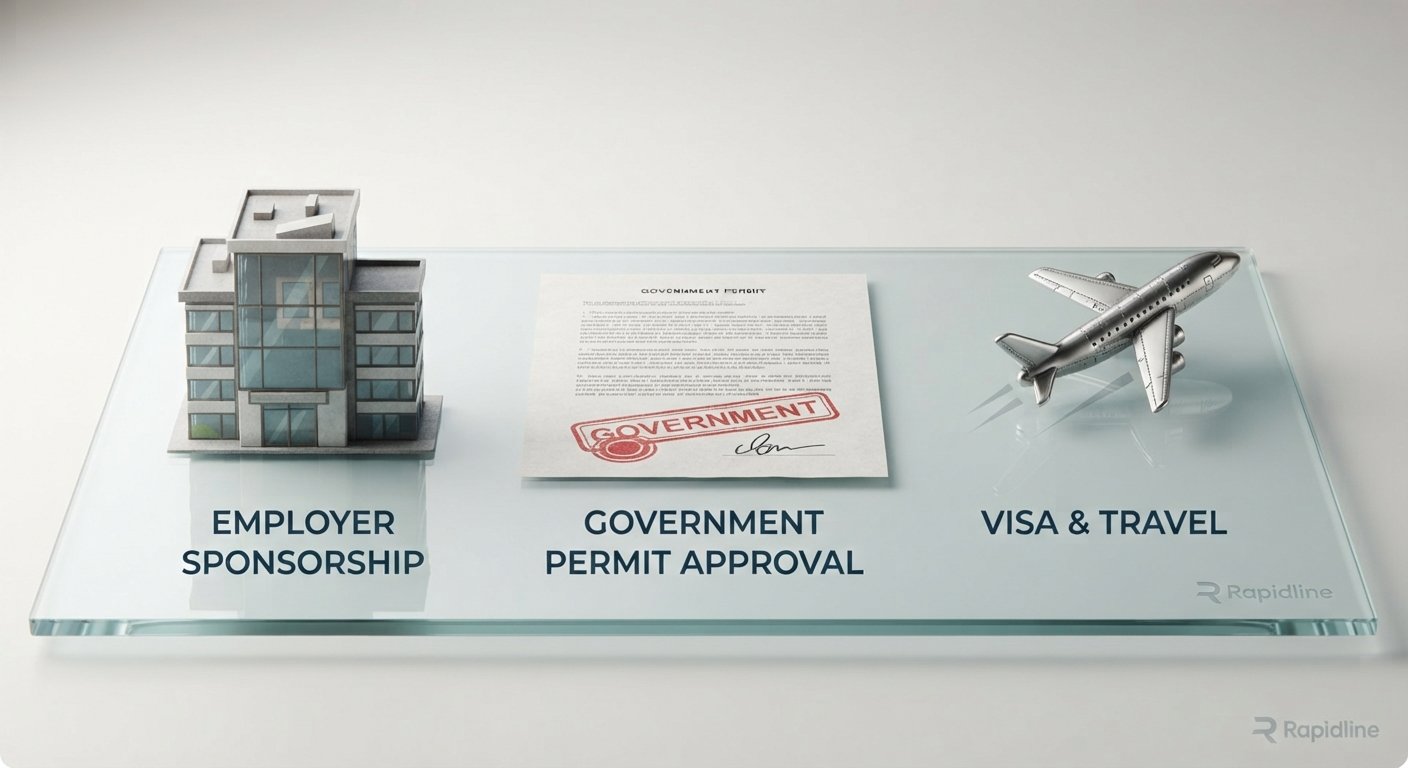
Stage one is your employer’s permit application, currently running without a binding deadline. Stage two is your national type D visa appointment and decision at the Polish consulate covering the UAE, which runs on the consulate’s own schedule and should be confirmed with them directly. Stage three is your arrival, address registration and residence card, which Poland is moving fully online during 2026.
Build your exit from your current UAE job around stage one completing, not around a promised date. That means keeping your current income until the permit is actually in hand.
Is the System Still Approving Applications?
Yes, though the trend deserves an honest reading.
Poland issued 251,525 work permits to non-EU nationals in 2025, 29% more than 2024 and more than double the 2019 level, according to Poland’s Ministry of Family and Social Policy. That is a record annual total.
The same year also saw permits fall by 22% overall after mid-year policy tightening, reaching the lowest levels in seven years by the end of the period. Both facts are true. Approvals are still happening at scale, and the direction of travel through the year was tightening rather than loosening.
An agency that quotes you only the record number is selling. One that explains both is informing.
What Happens on 4 March 2026?
The suspension is currently set to lift on that date, which means the 60-day deadline would apply again to decisions taken afterward.
Do not read that as a switch that clears the backlog. A deadline returning does not delete the cases that accumulated while it was suspended, and offices coming back under a clock typically work through an older queue first. The realistic expectation is that timelines improve gradually through the spring rather than reset overnight.
It also does not mean waiting is the better strategy. Applications filed now are still being decided, and the volume data suggests the policy environment has been tightening rather than loosening. Holding back to wait for a friendlier deadline risks trading an uncertain timeline for a narrower approval environment.
Watch for one thing specifically: whether the suspension is extended. It was introduced by legislation in response to caseload pressure, and caseload pressure does not resolve on a calendar. If your plan depends on the March date, build in the possibility that it moves.

Does the Type D Visa Stage Have Its Own Wait?
Yes, and applicants routinely forget it when calculating their timeline.
After the permit is issued you still need a national type D visa from the Polish consulate covering the UAE, and that is a separate authority with its own appointment availability and its own decision period. Consular appointment slots are the constraint that catches most people, because they can be booked out well beyond the decision time itself.
Two practical consequences. First, start checking appointment availability while the permit application is still in progress, rather than after it is granted, so you understand the lead time you are working with. Second, confirm current requirements and fees directly with the consulate, since consular procedure is set separately from the permit process and changes on its own schedule.
Adding a realistic consular window to your plan is what turns an optimistic estimate into a usable one.
What Should You Do With This Information?
Stop asking how long it takes and start asking whether your file is complete, since that is the question that actually changes the answer. Do not resign from your UAE job on the strength of a promised date. Treat a guaranteed timeline as a warning sign, not reassurance, a point covered in how to spot a fake agent.
If you want your file checked for completeness before it is submitted, message the Rapidline team on WhatsApp and we will tell you what is missing.
